Your cart is currently empty!
Fuzhou Hongmiaoling Landfill Gas to Electricity
Project Description
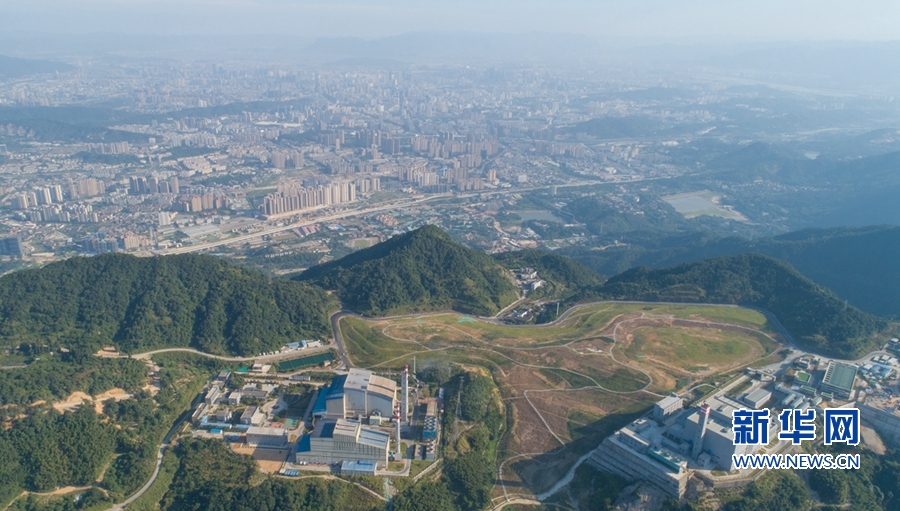
This project supports collection of landfill gas and generation of 2.5MW of electricity at a landfill in Fuzhou City in Fujian Province in southeastern China. The landfill received waste from 1995 until 2008, and—like most landfills—throws off methane as some of that waste decomposes. Credits are generated from two pieces of the project: (1) avoiding the emissions of methane (a potent greenhouse gas) into the atmosphere and (2) using the power generated from the methane (natural gas) to displace dirtier coal-fired power coming from the electric grid. The project clearly required carbon revenues to achieve these two goals and therefore generates high-quality carbon offsets.
Key Information
Developer
Fujian Tianyi Renewable Energy Technology & Utilization Co., Ltd.
Project Type
Landfill Gas Capture
Impact Type
Avoided Emissions
Permanence
100
Methodology
ACM0001
Verifier
Germanischer Lloyd Certification
Project Lifetime
2007 – 2017
Oxford Category
Oxford Type 1—Technology-based Reductions
Due Diligence
CNaught maintains a very high quality standard for all projects in the portfolios we manage. To ensure that a project meets this standard, we perform due diligence that’s backed up by third-party ratings agencies’ independent due diligence.
Additionality
This project has very high additionality, meaning it is very unlikely that this project activity could have occurred in the absence of carbon funding. Landfill gas capture programs were very rare in China when the project began. During our due diligence process, we found that while China is the world’s largest producer of municipal solid waste – the kind of waste that goes into landfills – it had less than 20 landfill gas capture programs by the time the project had begun1. Calyx has also rated this project highly in part because of its additionality.
Over-Crediting
This project has a low risk of over-crediting due to the fact that its emissions reductions are a direct measurement of the amount of methane captured and either combusted or used for energy. However, Calyx Global did cite that the project did not account for natural oxidation in their baseline calculation, which could result in slightly increased emissions reductions calculations. Natural oxidation is the process in which methane can sometimes permeate the cover used to seal the landfill, and migrate upwards where it is oxidized and converted into CO2. If projects use an oxidation factor that is too low, they risk over-calculating the amount of methane they capture. During our due diligence process, we reviewed the Fuzhou landfill’s geology, location, and size and found that it is likely to have 0 (or near 0) oxidation. Therefore, we believe that their risk of inaccuracy in their carbon accounting remains low2.
Durability
This project activity is highly durable as its emissions reductions are considered permanent, since the methane reductions it produces cannot be reversed. There is also no risk that the project activity would lead to the creation of new landfills and thus additional methane emissions. Because of this, the project is considered highly durable.
Double-Counting
The project credits have a very low risk of being double counted. There are no regulatory obligations being met by the project activity and the project’s registry, Verra, has mechanisms in place to ensure that the project is not registered in any other programs.
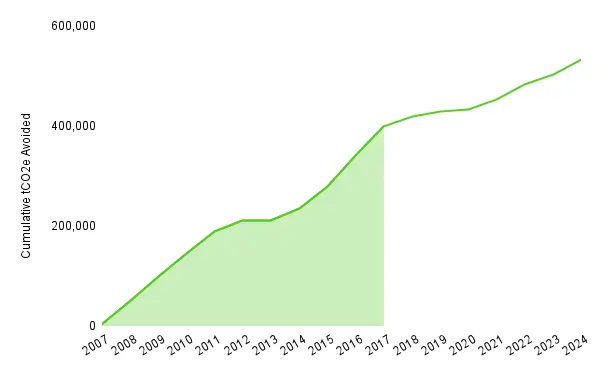
Figure shows the cumulative carbon dioxide emissions that this project avoided during its crediting period, shaded in green. This project required carbon credit funding to build the infrastructure and install the equipment necessary for landfill gas capture and conversion to energy. Because the landfill continues to produce methane, even though it stopped receiving credits in 2017, it continues to operate and provide continuous climate benefits even today! Note that: all data post 2017 is interpolated.
Beyond Carbon
Community and biodiversity co-benefits
This project provides significant community, health, and sustainable technology benefits.
Community: This project has trained and hired local residents to help operate its facilities, supporting the local economy while also ensuring that the project activity continues running smoothly. Human & Environmental Health: This project prevents contamination of local water supply and helps improve air quality. The project also prevents the risks of potential fires or explosions by capturing the methane produced from the landfill. Sustainable Technology: This project is introducing an important sustainable technology to China. Landfills are a significant source of methane emissions, and China, as both the world’s largest methane emitter and landfill waste contributor, has thousands of landfills1. Before the project began, China had less than 20 landfill gas collection projects2. This project, as well as other early landfill gas projects in China, helped introduce this clean technology to China, and has supported the scaling of implementation throughout the country in recent years. There is still a long way to go before this becomes common use in China though, and while the country did construct 510 new landfill gas collection facilities in 2020, it is estimated that ~80% of China’s landfills have not yet implemented methane gas collection3,4.
Risk of Reversal
This project has no risk of reversal because its avoided emissions are not subject to being undone.
Registry & Verification
Project Location
Project data sourced from CNaught carbon marketplace. Information may be updated periodically.